

muhendislik
August 15, 2026
Slipform in High Reinforced-Concrete Structures
Read article→
In the design and construction process of high-capacity reinforced concrete silos, the behavior of the stored material, horizontal pressures, reinforcement and prestressing systems, and the construction method must be evaluated together. In this article, we explain engineering solutions for different silo geometries, the advantages of slipform in large-scale applications, and the importance of site organization through projects completed by SİBA.
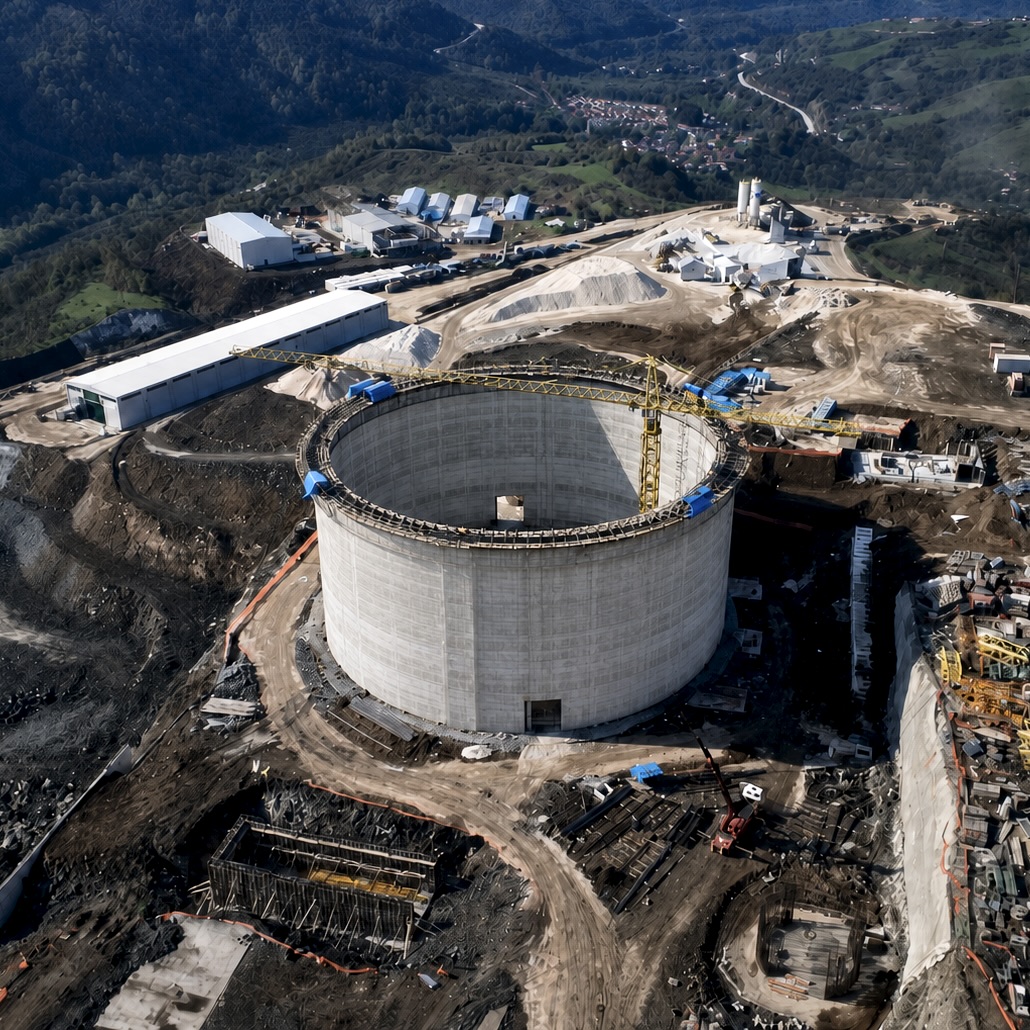
A silo is not merely a large reinforced concrete container into which material is filled. The weight and flow behavior of the stored product can create very high horizontal forces on the silo walls. During filling and discharge, the direction and distribution of these forces can also change.
For this reason, in silo construction, not only storage capacity but also the properties of the product, the discharge system, wall design, reinforcement arrangement, and construction method are important. Especially in tall and large-diameter silos, the reinforced concrete design and slipform application must be considered together.
A properly designed and executed reinforced concrete silo provides long service life, low maintenance requirements, and high storage capacity. The result of a faulty application may not be limited only to the reinforced concrete structure; it can directly affect the production line and the operation of the factory.
The material inside a silo is not a liquid. Therefore, wall pressure cannot be determined simply by a basic hydrostatic calculation based only on the filling height.
The unit weight, particle structure, moisture content, wall friction, and flow pattern of cement, raw meal, clinker, fly ash, gypsum, grain, or coal are all different from one another. The pressure generated during filling may also not be the same as the pressure during discharge.
Especially in cases of eccentric discharge or irregular flow, higher forces may develop on one side of the silo than on the other. Arching of the material inside and its subsequent sudden movement may also introduce additional effects on the structure.
Therefore, silo design does not consider only the "silo full" and "silo empty" conditions. Filling, discharge, different flow patterns, temperature, earthquake, and wind effects are evaluated together.
In multi-cell silos, loading conditions such as one adjacent cell being full while another is empty also become particularly important. The internal walls separating the cells must safely carry these pressure differences.
The first factor that determines the form of a silo is what will be stored inside it.
Raw meal silos are generally narrower and taller structures. The need for homogenization, the aeration system, and the internal bunker geometry become decisive in the design of the structure.
Clinker silos, on the other hand, can be built with very large diameters because they can reach very high capacities. In projects where the diameter reaches 60–70 metres, wall forces, the prestressing system, the large-span roof, discharge galleries, and site logistics must all be resolved together.
While material flow, tightness, and dust control come to the forefront in cement, fly ash, and gypsum silos, different operating conditions such as moisture, aeration, hygiene, and explosion safety become important in grain silos.
In some facilities, a multi-cell silo is preferred instead of a single large volume. In this way, different products or different batches of the same product can be stored in separate compartments within a single structural shell.
There is no single capacity limit valid for every storage need. However, as capacity, diameter, and height increase, reinforced concrete silos become a stronger option technically and economically.
The main advantages of reinforced concrete silos are as follows:
In order to obtain these advantages, crack control of the reinforced concrete shell, continuity of reinforcement, and joint details must be properly resolved; necessary protective coatings must be determined according to project conditions.
When a circular silo is filled, the horizontal pressure of the material creates circumferential tensile forces in the silo wall. Put simply, the structure tries to expand under internal pressure.
In conventional reinforced concrete design, these forces can be resisted by dense horizontal reinforcement. As the silo diameter and the pressure created by the stored material increase, the required amount of reinforcement also increases. It is necessary not only to calculate the reinforcement, but also to place it on the slipform platform in the correct sequence and with the correct lap splice details.
In large-diameter and high-capacity silos, prestressing can also be an effective solution. Prestressing tendons introduce circumferential compression into the silo wall in advance. In this way, the tensile effect to be created by the stored material is balanced, crack control is improved, and the need for conventional reinforcement can be made more efficient.
Not every silo has to be prestressed. The decision should be made based on the diameter, wall forces, spans, crack limits, and economic comparison.
Prestressing is not an independent operation added to the structure after the slipform is completed. An important part of the system is prepared together with the reinforced concrete shell while the slipform is rising.
Tendon ducts, anchorage zones, anchorage plates, embedded parts, and prestressing buttresses can be formed during the slipform operation. Depending on the system used, the placement of the tendons can be carried out while slipforming continues or after the shell is completed.
The stressing operation is carried out after the concrete reaches the required strength. The stressing forces and tendon elongations are measured and compared with the design values; then the necessary grouting and protection procedures are completed.
SİBA is experienced in planning and executing slipform and prestressing works together. Success here depends not so much on knowing the two systems separately, but on being able to carry them out together in the correct sequence and with precision.
In silos, the main storage shell is mostly of constant diameter, and the wall thickness continues unchanged over a long section. However, due to the bunker level, large openings, or high local forces, a thicker wall may be needed in the lower section.
In this case, the slipform system can be narrowed at the specified elevation to transition to a thinner main shell. Depending on the project, it is possible to move within a few days from a lower wall at the level of 80–100 centimetres to a main shell thickness in the range of 30–50 centimetres.
Silos repeated side by side or within the same facility are among the applications in which slipform is strongest.
If a sufficient quantity of slipform systems, hydraulic equipment, and experienced crews is allocated to the project, different silo groups can be raised on close dates or simultaneously. In this way, the production schedule does not remain dependent on dismantling a single formwork set and moving it sequentially to the other silos.
One concrete example of this approach is the Adoçim Samsun Port Silos project carried out by SİBA. In the project, which included four reinforced concrete silos each 20 metres in diameter and 45 metres high, three slipform sets were used simultaneously and the silo shells were raised in parallel.
SİBA’s extensive slipform equipment inventory enables it to deploy multiple systems in the same period in repetitive or multi-cell silo projects. However, speed does not come only from the number of equipment units; formwork capacity, experienced crews, reinforcement preparation, concrete production, crane planning, shift organization, and backup equipment must be managed together. In this way, the project schedule can be established not according to the circulation of a single formwork set, but according to the targeted delivery time.
The Baştaş clinker silo, carried out by SİBA for the Vicat Baştaş Cement Factory in Ankara, has a storage capacity of 150.000 tons and a diameter of 67,8 metres.
The standout feature of the project is the very large diameter of the silo. Raising the reinforced concrete shell with a diameter of approximately 68 metres by slipform requires high formwork capacity, uninterrupted concrete and reinforcement organization, and precise level control.
This project is one of SİBA’s important references showing that slipform is an effective solution not only for tall structures, but also for very large-diameter and high-capacity silos.
The Norm Cement Baku multi-cell silo project, carried out by SİBA in Azerbaijan, has a capacity of 14.500 m³ and six independent cells.
In the project, after completion of the bunker level, the internal cell walls and the external silo walls were raised together within the same slipform operation. Thus, the large reinforced concrete shell forming six separate storage cells was completed with a single production setup.
In such multi-cell structures, the simultaneous progress of the internal and external walls requires a large-volume slipform system, correct hydraulic load distribution, and uninterrupted reinforcement organization.
Missing or faulty reinforcement in the silo shell, incorrect lapping, insufficient cover, poor concrete surface, or an incorrectly positioned embedded part may lead to serious problems after the structure is put into operation.
Under high horizontal pressure, cracks may grow, tightness may be impaired, and the protection of the reinforcement against corrosion may weaken. Deformations affecting the discharge arrangement or problems at bunker connections may also disrupt the operation of the facility.
To carry out comprehensive repairs in a large silo, it is often necessary to empty the product and stop the relevant production line. In this case, the cost can go far beyond the reinforced concrete repair cost and turn into production loss for the factory.
The real value is not finding a solution after a problem arises, but preventing the problem from occurring through proper design and execution.
For this reason, a silo project should be carried out by experienced teams that understand reinforced concrete design, material flow, slipform, reinforcement, and, where applicable, the prestressing system together.
Why is a high amount of reinforcement used in silo walls?
The horizontal pressure of the stored material creates large circumferential tensile forces in circular silo walls. These forces are resisted by horizontal reinforcement, prestressing, or the combined use of both systems.
Should every large silo be built as prestressed?
No. The prestressing decision is made according to the silo diameter, storage load, spans, crack control requirement, and economic comparison. It can provide significant advantages in large-diameter and high-capacity silos.
In what dimensions can reinforced concrete silos be built?
Reinforced concrete silos can be built, depending on the project, in diameters ranging approximately from 6–8 metres to 80–100 metres. Their heights can start from 15–20 metres and reach 100 metres, or even higher levels.
What products can be stored in reinforced concrete silos?
Reinforced concrete silos can be used for storing cement, raw meal, clinker, fly ash, gypsum, grain, coal, fertilizer, and similar bulk materials. The silo geometry and internal systems are determined according to the properties of the product to be stored.
Can silo wall thickness be changed during slipforming?
Yes. The formwork system can be narrowed at a certain elevation to transition from the thicker lower section to the thinner main silo shell within a few days.